


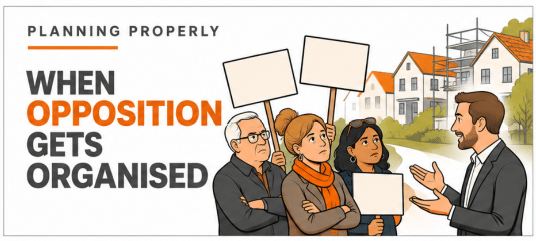
There’s a difference between a few residents expressing concerns about a proposed development and organised opposition to development.
One involves questions, objections and perhaps the occasional heated exchange on the local Facebook page.
The other has a campaign name, a petition, a dedicated WhatsApp group, matching posters in people’s windows and someone who has become remarkably proficient at contacting local journalists.
Welcome to organised opposition.
For housebuilders and developers, this can quickly change the dynamics surrounding a planning application. What began as a relatively straightforward proposal can become a local talking point, attracting political attention, media interest and a growing number of people who may not have looked at the plans themselves.
So, how should developers respond?
Understand who’s driving the opposition
The first mistake is assuming that everyone objecting to a scheme is objecting for the same reason.
They aren’t.
Some residents may have genuine concerns about traffic, infrastructure or the impact on their immediate surroundings. Others may oppose the principle of development altogether. Some may be influenced by information circulating locally, while others may simply be supporting their neighbours.
An organised campaign can bring all these voices together under one banner, but that doesn’t mean they share identical priorities.
Understanding the people involved, their motivations, their influence and their relationships with other stakeholders is an important first step.
This is where proper stakeholder mapping becomes particularly valuable. Not simply compiling a list of local councillors and residents’ associations, but understanding the relationships and issues that are shaping the conversation.
Don’t mistake volume for consensus
A petition with hundreds of signatures or a particularly vocal public meeting can create the impression that an entire community is opposed to a development.
But the loudest voices aren’t necessarily representative of everyone affected.
There may be residents who support the scheme, businesses that welcome the investment or people who are broadly positive but haven’t felt compelled to attend a meeting or comment online.
Equally, a large number of objections shouldn’t automatically be dismissed as the work of a vocal minority.
The challenge is to establish a more accurate picture of local opinion.
That means looking beyond the campaign itself, understanding the wider community and making sure different perspectives have a reasonable opportunity to be heard.
Separate genuine concerns from misinformation
Organised opposition campaigns can be highly effective at communicating a simple message.
Unfortunately, planning proposals are rarely simple.
A development involving hundreds of pages of technical assessments, design documents and planning reports can quickly be reduced to a single claim on a campaign leaflet.
Sometimes that claim is accurate. Sometimes it lacks context. And sometimes it is simply wrong.
Developers need to distinguish between legitimate objections, differences of opinion and factual inaccuracies.
If a concern is genuine, it deserves a proper response. If information is incorrect, it should be challenged with clear, accessible evidence.
And if the scheme itself needs reconsidering, that should be part of the discussion too.
The objective isn’t to discredit the opposition. It’s to make sure the public conversation is informed by what is actually being proposed.
Recognise when the conversation becomes political
Once an opposition campaign gathers momentum, elected representatives may become involved.
Councillors are approached by residents, local political groups take an interest and the development may attract attention beyond the immediate neighbourhood.
At this point, understanding the local political environment becomes particularly important.
Who represents the area? What concerns have they raised? What commitments have been made publicly? How does the proposal fit within the wider planning and policy context?
Developers need to understand these dynamics and engage appropriately, respecting the formal planning process and the responsibilities of elected members.
At Proper PR, this is an area where our experience makes a real difference.
Our co-founder Russell Quirk has first-hand experience of local government and planning committees, including serving as a Planning Committee Chairman.
That insight helps us understand not just how planning decisions are made, but how local concerns, political considerations and public communications can interact throughout the process.
Give the community something more useful than a rebuttal
When opposition becomes organised, there’s often a temptation to respond with a lengthy statement explaining why the campaign is wrong.
Occasionally, a correction is necessary.
But a communications strategy built entirely around rebuttals is unlikely to achieve very much.
A more constructive approach is to create opportunities for meaningful dialogue.
That could involve targeted meetings with community representatives, accessible information sessions, direct engagement with affected residents or clearer explanations of how particular concerns are being addressed.
Crucially, the developer needs to demonstrate that feedback is being considered, rather than simply collected.
People may not agree with the eventual outcome, but there is a considerable difference between disagreeing with a proposal and feeling that nobody has listened.
One scheme. One joined-up communications strategy.
This is where developers can make life unnecessarily difficult for themselves.
The planning consultant is handling technical matters. Someone internally is responding to residents. The marketing team is preparing project updates. A director is speaking to a councillor. Meanwhile, the local press has contacted the office and nobody is entirely sure who should respond.
Individually, everyone may be doing their job.
Collectively, the communications can become fragmented.
Organised opposition requires a coordinated approach, with clear responsibilities, consistent information and a proper understanding of the audiences involved.
That doesn’t mean every communication should sound identical. It means every part of the strategy should be working towards the same objective.
At Proper PR, we can manage that process from beginning to end.
From initial research and stakeholder mapping to political engagement, community consultation, media relations, digital communications and ongoing issues management, we bring the different elements together into one coordinated strategy.
We work alongside the developer and planning team, ensuring communications support the wider project rather than becoming another problem to manage.
Opposition isn’t always the enemy
It’s worth remembering that organised opposition doesn’t automatically mean a development is fundamentally flawed.
Nor does it mean the people raising objections are unreasonable.
Communities care about where they live, and development can bring significant change. They have every right to ask difficult questions, organise themselves and challenge proposals.
The developer’s responsibility is to respond professionally, communicate accurately and engage constructively.
Good stakeholder engagement won’t make every objection disappear. Nor should that be the objective.
But it can help prevent misunderstandings from escalating, identify opportunities for constructive dialogue and ensure that decisions are informed by a clearer understanding of the scheme.
And if the local campaign has already acquired a name, a logo, a petition and its own unofficial spokesperson, it might be time to make sure your communications strategy is equally well organised.
Preferably before someone orders the matching T-shirts.
Planning Properly with Proper PR
At Proper PR, we help housebuilders and developers navigate complex planning communications, organised opposition and sensitive community relationships.
With first-hand planning committee experience, property expertise and established media relationships, we can develop and manage the entire stakeholder engagement and communications strategy, from the first conversations through to planning determination and beyond.
Find out more about our Planning & Stakeholder Engagement service, or contact russell@properpr.co.uk to discuss how we can support your next development.